The Question
Who do you say that He is?

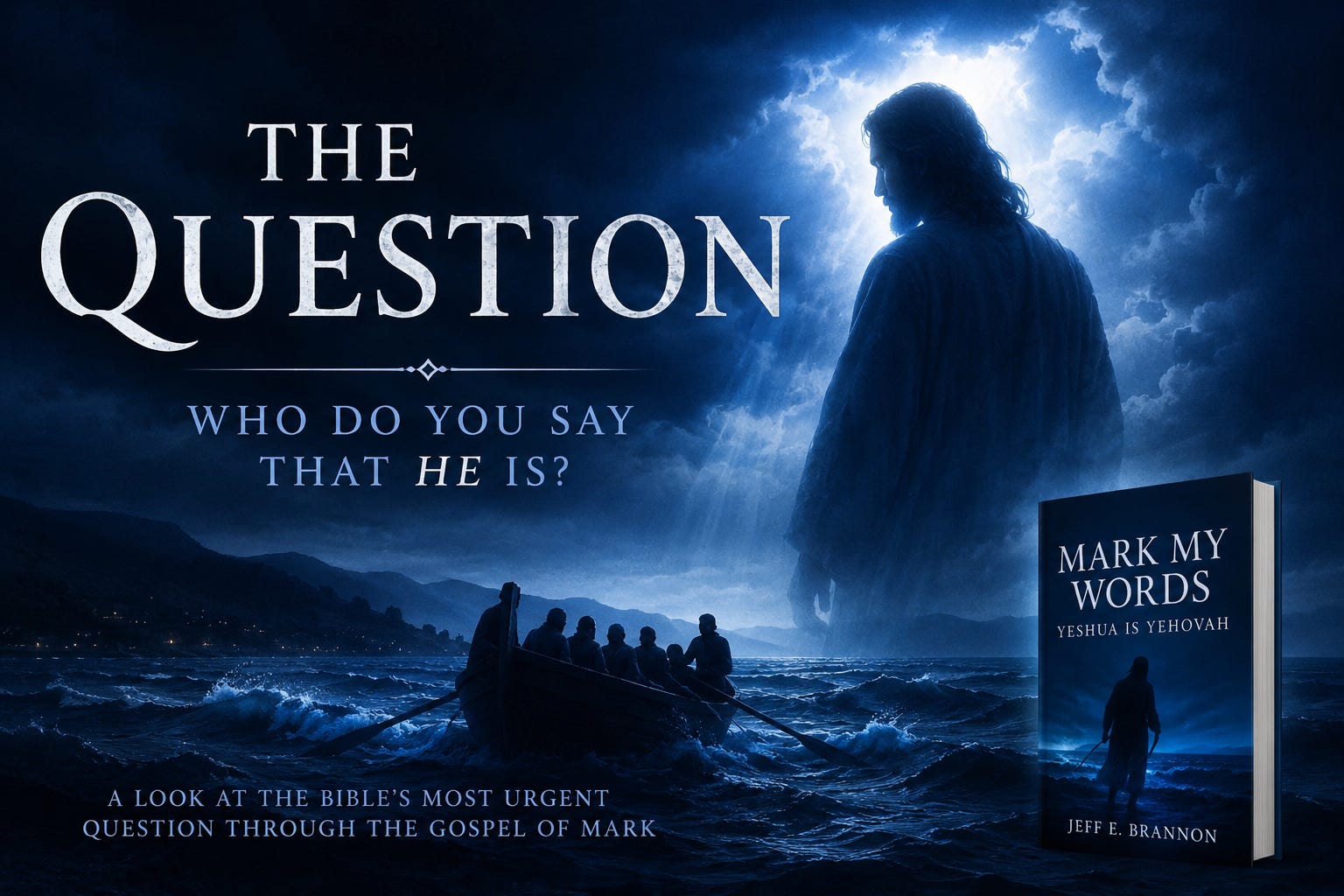
“Who do you say that I am?” (Matthew 16:15)
Two thousand years later, His question still divides the world.
Ask ten people who Jesus is, and you’ll get ten different answers: a prophet, a teacher, a moral revolutionary, a myth, an archangel, one of many “ascended masters.” What you’ll rarely hear, even in some churches, is the answer the earliest Christians died for: that Yeshua is Yehovah, the God of Israel, in the flesh.
That answer is under quiet siege right now. Some progressive theology recasts Him as a wisdom teacher whose divinity was a later invention. Islam honors Him as a prophet while explicitly denying His deity, His crucifixion, and His resurrection. Jehovah’s Witnesses identify Him as a created being, Michael the archangel in disguise. New Age and interfaith movements slot Him in as one “ascended master” among many, alongside Buddha and Muhammad, all equally valid paths up the same mountain.
These aren’t fringe positions anymore. They’re mainstream, well funded, and increasingly persuasive to people who’ve never been shown the alternative case. I didn't write this book because I wanted another theological debate. I wrote it because I've watched more and more people confidently say, "Jesus never claimed to be God," often without ever reading one Gospel carefully from beginning to end. That burden led me back to Mark, and what I found there became this book.
Why Mark, of All Places?
Most books defending the deity of Christ go straight to John. “In the beginning was the Word, and the Word was God.” It’s the obvious proof text, and a good one. But I wanted to make a different case, using the one Gospel that almost never gets used for this purpose: Mark.
Mark doesn't begin with a theological declaration like John. He builds his case through actions, allusions, and fulfillment until the evidence becomes impossible to ignore. Yeshua forgives sins outright, something the religious leaders immediately recognize only God can do. He speaks to a storm and it obeys Him instantly, the way Yehovah speaks to the sea in the Psalms. He walks on water rather than through it. He feeds thousands in the wilderness the way Yehovah fed Israel with manna. He accepts the titles, authority, and honor that belong to Yehovah alone.
None of this is incidental. Mark is quietly, deliberately building a case, allusion by allusion, miracle by miracle, until the reader has no honest way to conclude anything except what the centurion says at the foot of the cross: “Truly this man was the Son of God.”
Mark My Words walks through the entire Gospel of Mark chapter by chapter, tracing that thread from the first verse, where Mark applies an Old Testament prophecy about Yehovah’s own arrival directly to Yeshua, all the way to the empty tomb.
Facing the Objections Honestly
I didn’t want to write a book that only preaches to people who already agree. So before ever opening Mark, the book stops to take the modern denials seriously, not as strawmen to knock down, but as real positions held by real people:
“He was just a man.” The view shared by secular scholarship and Islam alike, that later communities projected divinity onto a human teacher.
“He was a created being.” The Arian view, revived today in Jehovah’s Witnesses and parts of Mormonism, exalted, but not eternally God.
“He’s one of many paths.” The Baháʼí and New Age view, Yeshua as an enlightened teacher among equals.
Each one gets a fair hearing and then a scriptural answer, from Yeshua’s own claim “before Abraham was, I AM,” to Paul’s declaration that “in Him dwells all the fullness of the Godhead bodily,” to His own words: “no one comes to the Father except through Me.” The goal isn’t to win an argument for its own sake. It’s to show that the deity of Christ isn’t a fourth-century invention imposed on a simple rabbi. It’s the consistent testimony of the text itself, from Genesis to Revelation.
Why This Matters More Than It Seems To
This isn’t an abstract doctrinal footnote. If Yeshua is merely a good man, His death carries no more power to save than any other martyr’s, and the cross becomes a tragedy rather than an atonement. But if He is Yehovah in the flesh, if the eternal God Himself walked among us, bled for us, and rose again, then everything changes. Worship of Him then isn’t idolatry. Obedience to Him isn’t devotion to a wise teacher; it’s obedience to God’s own voice. And the gospel isn’t a nice philosophy. It’s the record of the Creator entering His creation to rescue it.
That’s the awe this book is trying to restore. Not a theological abstraction to win a debate, but the staggering claim sitting quietly inside a Gospel most people think they already know.
Every generation must answer the same question.
Not whether Jesus existed.
Not whether He was a good teacher.
Not whether He changed history.
But the question He asked His own disciples:
“Who do you say that I am?”
Your answer changes everything.
If you’d like to walk through the Gospel of Mark and examine that question one passage at a time, I invite you to read Mark My Words: Yeshua is Yehovah.
Get your copy here: https://a.co/d/08elov81